Foto av Sharrie Shaw
Hotell med 5 stjärnor i Surakarta
- Ändra digBoka hotell med gratis avbokning
- Var kräsenSök bland nästan en miljon boenden i hela världen
Kontrollera tillgänglighet för 5-stjärniga hotell i Surakarta
Ikväll
Imorgon
Nästa helg
Om två veckor
Våra rekommendationer för 5-stjärniga hotell i Surakarta
Priset är 661 kr
inklusive skatter och avgifter
9 jan. – 10 jan. 2026

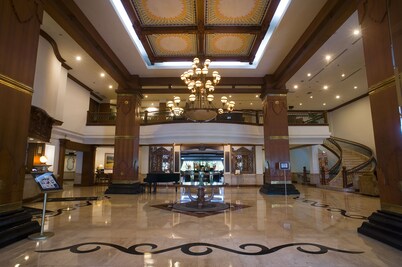
The Royal Surakarta Heritage - Handwritten Collection
The Royal Surakarta Heritage - Handwritten CollectionCentrala Solo
8.2 av 10, Väldigt bra, (166)
Priset är 359 kr
inklusive skatter och avgifter
4 jan. – 5 jan. 2026
Spara i genomsnitt 10 % på tusentals hotell när du är inloggad
Utforska liknande 4-stjärniga hotell
Många 4-stjärniga hotell har samma bekvämligheter som 5-stjärniga hotell. Se alla 4-stjärniga hotell i Surakarta.

Novotel Solo
Jalan Slamet Riyadi 272 Surakarta Central Java
Priset är 394 kr per natt mellan 11 jan. och 12 jan.
394 kr
11 jan. – 12 jan. 2026
inklusive skatter och avgifter
8/10 Very Good! (113 recensioner)
Hittar du inte det du letar efter?
Se alla boenden i Surakarta.
Du kan även använda de här populära alternativen för att filtrera din sökning.
Lägsta pris per natt som vi hittade under de senaste 24 timmarna, baserat på 1 natt för 2 vuxna. Priser och tillgänglighet kan komma att ändras. Ytterligare villkor kan gälla.
Recensioner av topphotell i Surakarta
Lär dig mer om Surakarta
Reseguide: Hotell med 5 stjärnor i Surakarta
Sök efter hotell i Surakarta på Expedia.se. Du hittar snabbt hotell i Surakarta genom att använda någon av metoderna nedan:
- Visa vårt utbud av hotell i Surakarta
- Använd kartan för att hitta hotell i det område i Surakarta som du föredrar
- Använd filtren för att visa hotell i ett visst område i Surakarta eller för att välja tema, kedja eller hotellklass, från enklare hotell (1 stjärna) till lyxhotell (5 stjärnor) i Surakarta
- Ange dina resdatum så får du se de bästa erbjudandena på hotell i Surakarta – medan de fortfarande finns kvar
![At the museum no photos are allowed which is really unfortunate as it was well worth the visit and the guided tour is definitely not to be missed. In the museum there are even Batik made from the Dutch era which depicts stories like Little Red Riding Hood and Snow White!
I enjoyed the tour v much and at the end of the tour we were brought to this room where the artisan were working on hand drawn batik.
Below is an excerpt from Wikipedia for anyone interested in learning more about the process of batik making.
Firstly, a cloth is washed, soaked and beaten with a large mallet. Patterns are drawn with pencil and later redrawn using hot wax, usually made from a mixture of paraffin or bees wax, sometimes mixed with plant resins, which functions as a dye-resist. The wax can be applied with a variety of tools. A pen-like instrument called a canting (IPA: [tʃantiŋ], sometimes spelled with old Dutch orthography tjanting) is the most common. A canting is made from a small copper reservoir with a spout on a wooden handle. The reservoir holds the resist which flows through the spout, creating dots and lines as it moves. For larger patterns, a stiff brush may be used. Alternatively, a copper block stamp called a cap (IPA: [tʃap]; old spelling tjap) is used to cover large areas more efficiently.
After the cloth is dry, the resist is removed by scraping or boiling the cloth. The areas treated with resist keep their original color; when the resist is removed the contrast between the dyed and undyed areas forms the pattern. This process is repeated as many times as the number of colors desired.
The most traditional type of batik, called batik tulis (written batik), is drawn using only the canting. The cloth need to be drawn on both sides and dipped in a dye bath three to four times. The whole process may take up to a year; it yields considerably finer patterns than stamped batik.
Source: Wikipedia](https://images.trvl-media.com/place/6224808/26fd1460-c65a-4c1a-9444-7a893e883ac9.jpg?impolicy=fcrop&w=1200&h=500&q=medium)


![At the museum no photos are allowed which is really unfortunate as it was well worth the visit and the guided tour is definitely not to be missed. In the museum there are even Batik made from the Dutch era which depicts stories like Little Red Riding Hood and Snow White!
I enjoyed the tour v much and at the end of the tour we were brought to this room where the artisan were working on hand drawn batik.
Below is an excerpt from Wikipedia for anyone interested in learning more about the process of batik making.
Firstly, a cloth is washed, soaked and beaten with a large mallet. Patterns are drawn with pencil and later redrawn using hot wax, usually made from a mixture of paraffin or bees wax, sometimes mixed with plant resins, which functions as a dye-resist. The wax can be applied with a variety of tools. A pen-like instrument called a canting (IPA: [tʃantiŋ], sometimes spelled with old Dutch orthography tjanting) is the most common. A canting is made from a small copper reservoir with a spout on a wooden handle. The reservoir holds the resist which flows through the spout, creating dots and lines as it moves. For larger patterns, a stiff brush may be used. Alternatively, a copper block stamp called a cap (IPA: [tʃap]; old spelling tjap) is used to cover large areas more efficiently.
After the cloth is dry, the resist is removed by scraping or boiling the cloth. The areas treated with resist keep their original color; when the resist is removed the contrast between the dyed and undyed areas forms the pattern. This process is repeated as many times as the number of colors desired.
The most traditional type of batik, called batik tulis (written batik), is drawn using only the canting. The cloth need to be drawn on both sides and dipped in a dye bath three to four times. The whole process may take up to a year; it yields considerably finer patterns than stamped batik.
Source: Wikipedia](https://images.trvl-media.com/place/6224808/26fd1460-c65a-4c1a-9444-7a893e883ac9.jpg?impolicy=fcrop&w=300&h=400&p=1&q=high)