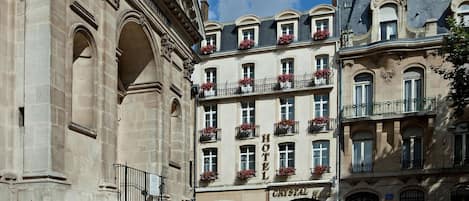
A private mansion dating from the end of the 19th century, the Villa Lepois & Spa classified as a 5* furnished tourist accommodations are located in the heart of Nancy in the historic Lepois-Ravinelle district, five minutes from the hyper center of Nancy, the Old City – Leopold district, the train station and the Place Carnot. Decorated and furnished with refinement, the Villa Lepois, testimony to the art nouveau movement, offers you a haven of peace and change of scenery where the calm and well-being of the occupants remains the priority.
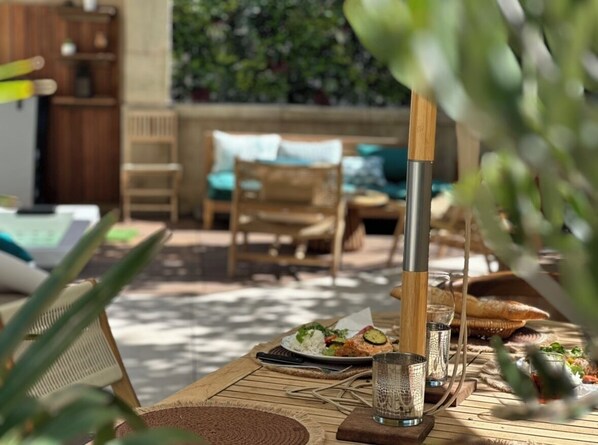
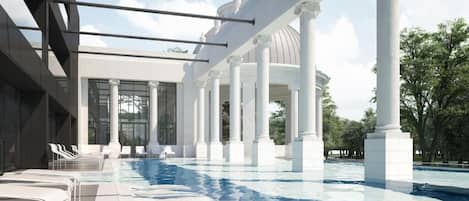
The main entrance gate of the Villa located on rue Lepois opens onto an outdoor area with exotic wood and Burgundy stone flooring allowing you to relax comfortably in a sun lounger, the sofa area, the various benches, at the foot of a hundred-year-old lime tree or in an outdoor wellness and therapeutic spa with different programs and types of massage that can accommodate and relax up to 6 people.
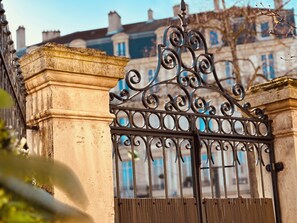
The second gate located on Quai Claude le Lorrain will allow you to enter a vehicle and/or enjoy the joys of a table tennis table and a BBQ.
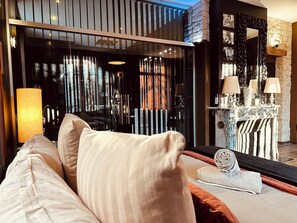
The main entrance door of the Villa opens onto a living room of approximately 100 m2 with its dining areas, sofa, reading, gaming and equipped kitchen, a central staircase in Burgundy stone leading to the two upper floors as well as a bathroom and toilet fitted out for people with reduced mobility.
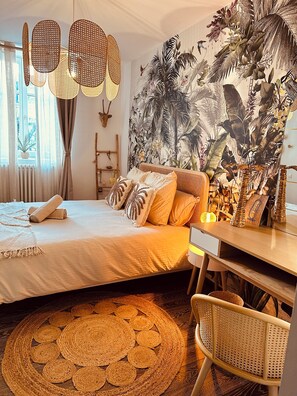
On the upper floors, the Villa offers a Master suite, a suite as well as 3 double bedrooms, 3 bathrooms and toilets are at the service of the occupants.
The villa can accommodate up to 10 people, the supply of household linen is provided (sheets and towels provided) as well as shower gel, shampoo and toilet paper.
Cleaning carried out by us at the end of the stay (intermediate cleaning(s) possible on request).
Closed private parking on site possible (1 to 2 spaces depending on the size of the vehicle).
Breakfasts on request.
Enjoy the Villa Lepois.
Calm and respect for the neighborhood required for the well-being of the occupants (parties prohibited).
Near the Villa you will find supermarket, bakery, butcher and gas station.
A little history...
With 267 listed monuments, Nancy is the 4th city in France with the most historical monuments. This large number of jewels is linked to its rich past and is the result of the history of the ducal city, capital for centuries of an independent country, the Duchy of Lorraine. On the death of the last Duke of Lorraine Stanislas in 1766, the Duchy of Lorraine was attached to France and Nancy became French
Nancy experienced a new golden age at the end of the 19th century, the city thus becoming one of the richest cities in France again. It was a capital but, this time, an industrial one. Nancy, the largest city in the East, is growing even more. A border town, a refuge for Lorraines and Alsatians, a garrison town, a city of communication between North and South and the heart of Europe, by rail, waterways or by land, it has thus become a very large city with a powerful trade, diversified education and multiple industries including metallurgy. Many fortunes were established there and the building industry was in full swing, architects, entrepreneurs and artists expressed themselves in new projects.
Nancy is also the cradle of Art Nouveau. From 1871, the conditions were met for this modern style to be born around illustrious names such as Gallé, Corbin and Majorelle. The School of Nancy and the Art Nouveau movement have thus left many testimonies in the city, creating a remarkable private heritage, as illustrated through the rue Lepois.
Rue Lepois is thus a very unique place in Nancy, presenting a set of private mansions and bourgeois buildings with remarkable architecture. This street, opened in 1875, pays tribute to an illustrious figure of the sixteenth century born in 1563 in Nancy, Charles Lepois (1563-1633), French physician, first Professor and Dean of the Faculty of Medicine of the University of Lorraine located in Pont-à-Mousson and known throughout Europe.
Walking along this street and its surroundings, one can admire the fruits of the architectural and sculptural art of the late nineteenth century, the achievements of eminent architects such as Ferdinand Genay and Louis Lanternier. The Villa and these residences amaze with their white stone facades and refined sculptures. Each building tells a story and the elegance of the past era is still palpable in every urban detail.
On the 1st floor,
The Master Suite "Cour